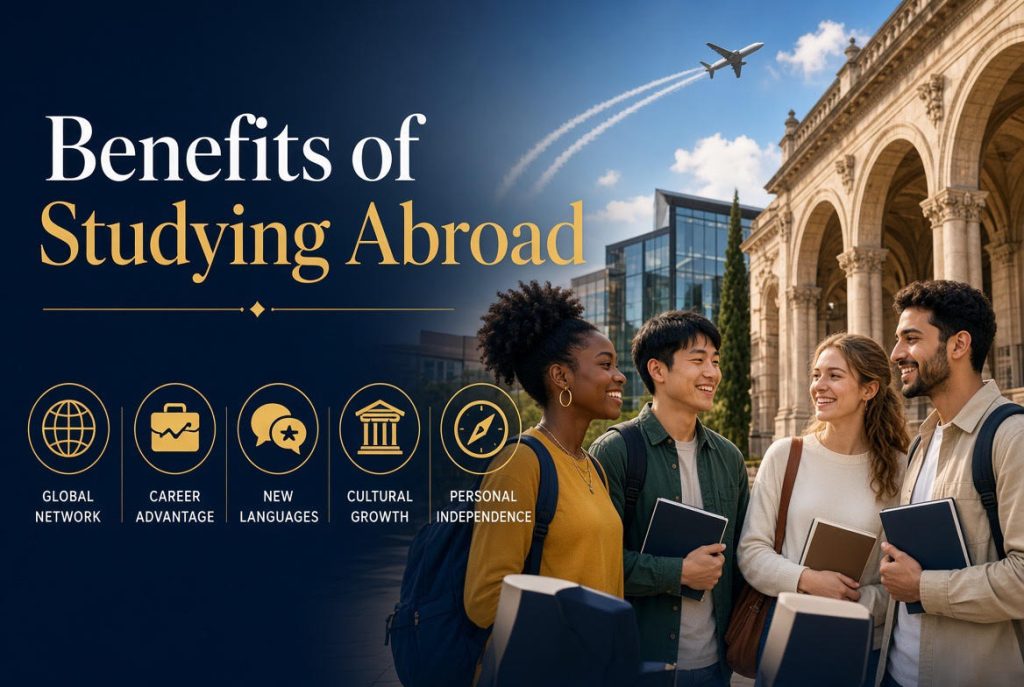
The Life-Changing Benefits of Studying Abroad: Why It Could Be the Best Decision You’ll Ever Make
Have you ever imagined yourself stepping off a plane in a completely different country, surrounded by new languages, cultures, and opportunities? Picture the excitement of starting a new chapter where every day challenges you to grow, learn, and discover what you’re truly capable of. If you’re exploring the benefits of studying abroad, you’re already considering one of the most transformative investments you can make in your future.
Studying abroad is about much more than earning a degree from an international university. It’s about breaking free from your comfort zone, gaining a global perspective, and building skills that employers around the world value. It’s an experience that can reshape your confidence, expand your network, and open doors to opportunities you may never have imagined.
In today’s interconnected world, students who have international experience often stand out from the crowd. They develop adaptability, independence, cultural awareness, and problem-solving skills that cannot be learned from textbooks alone. Whether you’re attending lectures in Canada, conducting research in the United Kingdom, networking in Australia, or exploring innovation hubs in New Zealand, every experience contributes to your personal and professional growth.
The benefits extend far beyond graduation. Many international students gain access to internships, post-study work opportunities, and global career pathways that can significantly improve their long-term earning potential. Others return home with fresh perspectives, advanced knowledge, and a competitive edge in their local job markets.
But perhaps the greatest reward is personal transformation. Living and studying in another country teaches resilience, self-reliance, and confidence. You learn how to navigate unfamiliar environments, build friendships across cultures, and embrace challenges with courage. These experiences shape not only your career but also the person you become.
Whether you’re comparing destinations, calculating costs, searching for scholarships, or simply dreaming about what life could look like beyond your borders, understanding the true benefits of studying abroad is the first step toward making an informed decision.
In this comprehensive guide, we’ll explore the real-world advantages of international education, from academic excellence and career opportunities to personal growth and cultural immersion. By the end, you’ll have a clear understanding of why millions of students choose to study abroad every year—and why it could be one of the best decisions you ever make.
Your future may be waiting on the other side of a passport stamp. Let’s explore the possibilities together.
Why the Benefits of Studying Abroad Matter More Than Ever
In our increasingly connected world, staying local can sometimes feel limiting. Studying abroad throws you into experiences that sharpen your mind, expand your heart, and supercharge your future. Research consistently shows that students who go abroad return more confident, adaptable, and employable.
It’s like hitting the fast-forward button on personal and professional growth. You don’t just learn facts—you live them. And with 2026 bringing even more opportunities through new programs and post-study work options, there’s never been a better time.
Personal Growth: One of the Greatest Benefits of Studying Abroad
One of the most talked-about benefits of studying abroad is how it transforms you as a person. Leaving your comfort zone forces you to adapt, solve problems on the fly, and discover strengths you didn’t know you had.
Key ways it builds you up:
- Boosted confidence and independence: Navigating a new city, managing finances, and making friends in a foreign language turns everyday challenges into triumphs.
- Resilience and adaptability: Dealing with culture shock or unexpected hurdles teaches you to bounce back stronger.
- Broader worldview: You’ll question assumptions and gain empathy by seeing life through different cultural lenses.
- Self-discovery: Many students return with clearer career goals and a deeper understanding of their values.
Imagine finishing a semester feeling more mature and self-aware. That’s the kind of growth that sticks with you for life.
Cultural Immersion and Global Perspectives
Few experiences match the depth of living in another culture. This is where benefits of studying abroad truly shine through daily life.
You’ll celebrate local festivals, try unfamiliar foods, and build friendships that cross borders. Language skills improve dramatically through real conversations rather than textbooks. Even if your program is in English, picking up phrases in the local language opens doors.
This immersion fosters intercultural competence—a skill employers desperately want in our global economy. You learn to communicate across differences, negotiate misunderstandings, and appreciate diversity in ways that enrich every relationship back home.
Academic and Intellectual Benefits of Studying Abroad
Don’t worry—studying abroad doesn’t mean slacking off. Many programs offer unique courses, research opportunities, and teaching styles you won’t find at home.
Advantages in the classroom:
- Access to specialized programs (think marine biology in New Zealand or engineering in Germany).
- Hands-on learning through field trips and internships.
- Improved grades and graduation rates—studies show participants often perform better and finish on time.10
- Exposure to international faculty and diverse classmates that spark creativity.
The result? A richer education that makes you a more well-rounded thinker.
Career Advantages: How Benefits of Studying Abroad Boost Your Job Prospects
Here’s where things get exciting for your future self. Employers love candidates with international experience, and the numbers back it up.
Students who study abroad often see:
- Higher starting salaries—up to $4,159 more in their first job according to recent data.
- Faster employment—97% find jobs within 12 months versus lower rates for non-participants.
- Stronger networks—lifelong connections with professors, peers, and alumni worldwide.
- Standout resumes—international experience signals adaptability, initiative, and global awareness.
Here’s a quick comparison table of career impacts:
| Aspect | Without Study Abroad | With Study Abroad | Real-World Edge |
|---|---|---|---|
| Employment Rate (12 months) | ~49-70% | 93-97% | Much faster job placement |
| Starting Salary Boost | Standard | +$4,000+ annually | Significant earnings premium |
| Graduate School Acceptance | Baseline | 90% into top choices | Stronger applications |
| Key Skills Gained | Academic knowledge | Adaptability, cross-cultural communication, problem-solving | Highly valued by employers |
This table highlights why so many graduates credit their abroad experience for opening doors.20
Long-Term Life Benefits of Studying Abroad
The impact doesn’t stop at graduation. Many alumni report lasting changes:
- Greater openness to travel and new experiences.
- Enhanced language abilities that support international careers.
- A global network that provides opportunities years later.
- Improved mental health and life satisfaction from broadened perspectives.
It’s an investment that pays dividends across your entire life—not just your CV.
Potential Challenges (And Why They’re Worth It)
To keep it real, studying abroad comes with hurdles like homesickness, adjusting to new systems, or higher costs. But these challenges are part of the growth. Most students say the benefits of studying abroad far outweigh the difficulties, and support services at universities make it manageable.
Tips to maximize your experience:
- Research programs that align with your goals.
- Apply for scholarships early.
- Stay open-minded and document your journey.
- Build a support system both abroad and at home.
Getting Started on Your Own Benefits of Studying Abroad Journey
Ready to take the leap? Start small: browse programs, talk to alumni, and create a budget. Resources like official study portals can guide you.
For more inspiration on destinations and programs, check this excellent overview: https://www.gooverseas.com/
And for deep dives into career outcomes, explore this research hub: https://www.forumea.org/
The Bottom Line: Are the Benefits of Studying Abroad Really Worth It?
Absolutely.
For the right student, studying abroad can be far more than an academic experience. It can become one of the most transformative chapters of your life—shaping how you think, how you work, how you communicate, and how you see the world.
Yes, there are challenges.
You may have to deal with homesickness, financial pressure, unfamiliar academic systems, culture shock, and the responsibility of managing life independently. Leaving everything familiar behind isn’t always easy.
But those challenges can also become part of your growth.
The benefits of studying abroad extend far beyond receiving an international degree. You gain exposure to different cultures, develop independence, build international friendships, discover new career possibilities, and develop the adaptability required to thrive in an increasingly global world.
You Become More Independent
Living abroad often forces you to become responsible for yourself in ways you may not have experienced before.
You learn how to manage your finances, organize your schedule, navigate public transportation, communicate with unfamiliar people, solve unexpected problems, and make important decisions without always having family nearby.
These experiences can build confidence.
You begin to realize that you are capable of handling situations that once seemed intimidating.
That confidence can follow you into your professional life long after graduation.
You Gain a Global Perspective
One of the most valuable benefits of studying abroad is the opportunity to interact with people from different backgrounds.
You may study alongside students from dozens of countries, each bringing different experiences, beliefs, ideas, and approaches to solving problems.
You begin to understand that there isn’t always one correct way to approach a situation.
You learn to listen.
You learn to communicate across cultural differences.
You become more comfortable working with people who don’t think exactly like you.
In today’s global workplace, those skills can be incredibly valuable.
Your Career Can Benefit Too
An international education can also strengthen your professional profile.
Studying abroad can give you opportunities to develop language skills, participate in international projects, access research facilities, attend career events, complete internships, and build relationships with professionals from around the world.
You may discover career paths you had never considered before.
You may meet someone who introduces you to an industry.
You may develop skills that are highly valuable to international employers.
And when you eventually apply for jobs, your experience of adapting to a new country can demonstrate qualities such as independence, resilience, communication, adaptability, and problem-solving.
Of course, studying abroad doesn’t automatically guarantee a high-paying job. Your results will depend on your field, qualifications, experience, skills, and the job market.
But the experience can give you additional tools to compete.
You Build a Network That Can Follow You Around the World
Your international network can become one of the most unexpected benefits of studying abroad.
The person sitting next to you in class today could become a researcher, entrepreneur, engineer, consultant, policymaker, doctor, or business leader tomorrow.
You may graduate with friends and professional contacts across several countries.
Those relationships can create opportunities for collaboration, mentorship, employment, entrepreneurship, and further education.
Your university can become the starting point for a global professional network.
You Discover More About Yourself
Perhaps the most important benefit isn’t something that appears on your CV.
It’s the person you become.
Being away from your familiar environment gives you an opportunity to question assumptions, discover new interests, overcome fears, and understand what you actually want from life.
You may arrive abroad believing you know exactly what your future looks like.
Then something changes.
A class inspires you.
A professor introduces you to a new field.
A cultural experience changes your perspective.
An internship reveals a career you never considered.
A difficult experience teaches you resilience.
By the time you graduate, your goals may be completely different.
And that’s okay.
Growth doesn’t always look like following the plan you started with.
The Investment Can Be Bigger Than Money
Studying abroad can certainly be expensive, but it’s important to think about the investment beyond tuition fees.
You’re investing in education.
You’re investing in skills.
You’re investing in relationships.
You’re investing in experiences.
You’re investing in personal development.
And, potentially, you’re investing in future career opportunities.
That doesn’t mean you should ignore the financial reality.
Always research tuition, accommodation, transportation, insurance, food, visa costs, and other expenses before making a decision. Look for scholarships, grants, affordable universities, and legitimate funding opportunities where possible.
A dream becomes much more sustainable when it is supported by a realistic financial plan.
You Don’t Have to Follow Someone Else’s Journey
Studying abroad doesn’t have to mean copying someone else’s experience.
You don’t need to attend the most famous university in the world.
You don’t need to visit twenty countries.
You don’t need to have an Instagram-perfect student life.
Your journey may look completely different.
Perhaps your goal is to earn a Master’s degree and return home with specialized skills.
Perhaps you want to gain international work experience.
Perhaps you want to conduct research.
Perhaps you want to build an international business network.
Perhaps you simply want to experience another culture while developing academically.
The best study-abroad experience is one that supports your own goals.
So, Is It Worth It?
For many students, the answer is yes—but only when the decision is carefully planned.
Don’t study abroad simply because everyone else is doing it.
Choose a destination that fits your goals.
Choose a programme that supports your career.
Understand the costs.
Research funding opportunities.
Prepare for cultural adjustment.
Understand visa and post-study options.
And be honest about what you want from the experience.
If you do that, studying abroad can become much more than a temporary change of location.
It can become a foundation for the next stage of your life.
So, if you’re sitting in Nigeria—or anywhere else in Africa—dreaming about studying in another country, don’t automatically dismiss the idea because it feels too ambitious.
Research it.
Explore scholarships.
Compare universities.
Talk to students who have already done it.
Calculate the costs.
Understand the requirements.
Then decide based on facts rather than fear.
Thousands of students have already taken that first step and discovered opportunities they never imagined possible.
You could be next.
Your journey may begin with a scholarship application, a university search, a conversation with an adviser, or simply deciding that you’re going to take the dream seriously.
The world is bigger than the place where you started.
And studying abroad could give you the opportunity to experience it, learn from it, and return stronger because of it.
So don’t just ask, “Can I study abroad?”
Ask:
“What could my life look like if I prepared properly and gave myself the opportunity to try?”
That question could be the beginning of something extraordinary.
Your global adventure is waiting. Take the first step.