Introduction: Why Scholarships in German Universities Could Transform Your Future
What if studying at a world-class European university did not require you to take on overwhelming debt? What if you could earn a respected international degree, live in one of Europe’s most innovative countries, build a global network, and develop skills that employers value—all while receiving financial support to make the experience more affordable?
For many ambitious students, that possibility is exactly what makes scholarships in German universities so attractive.
Germany has become one of the most popular destinations for international students because it combines high-quality education, internationally respected universities, strong research opportunities, and relatively affordable study options. Many public universities do not charge traditional tuition fees for many programmes, although students are generally required to pay semester contributions, and there are important exceptions depending on the university, programme, and federal state.
That distinction matters.
Studying in Germany may be more affordable than studying in some other major destinations, but affordability does not mean that international students have no expenses. Accommodation, food, transportation, health insurance, study materials, visa requirements, and everyday living costs can still add up quickly.
This is where scholarships can make a major difference.
A good scholarship can help reduce the financial pressure that comes with moving to another country. Depending on the programme and funding organization, support may contribute toward tuition or fees where applicable, living expenses, travel, health insurance, research costs, or other study-related expenses.
For a student who has the academic ability but not the financial resources to fund an international education independently, that support can completely change what is possible.
And you do not have to come from a wealthy family to dream about studying in Germany.
Every year, international students from countries across Africa, Asia, Latin America, and other parts of the world explore German universities and scholarship opportunities. Nigerian students, for example, are increasingly interested in Germany because of its strong reputation in fields such as engineering, computer science, renewable energy, business, economics, environmental studies, public policy, medicine, and scientific research.
But scholarships are not simply about getting free money.
They are opportunities designed to support talented students who can demonstrate academic potential, clear goals, relevant experience, leadership, research interests, or a commitment to making an impact in their communities and professional fields.
That means your application needs to tell a convincing story.
Your grades matter, but they are only one part of the picture.
Selection committees may want to understand why you chose your programme, why Germany is relevant to your goals, what you have already accomplished, what you hope to achieve, and how the opportunity fits into your long-term plans.
This is why preparation is so important.
Germany Offers More Than a Degree
One of the biggest advantages of studying in Germany is the opportunity to become part of a highly international academic environment.
You are not simply attending lectures and completing assignments.
You could be studying alongside students from dozens of countries, working on international projects, participating in research, attending professional events, and developing friendships and professional relationships that could last for years.
Germany is also home to major industries and innovation ecosystems.
Depending on your field, studying there can expose you to companies, research institutions, startups, laboratories, conferences, and professional networks connected to some of Europe’s most important industries.
For students interested in technology and engineering, Germany’s reputation for innovation and manufacturing can be particularly attractive. For students interested in sustainability, the country’s work in renewable energy and environmental policy offers valuable academic and professional context.
For researchers and PhD candidates, Germany’s universities and research institutions can provide opportunities to work on projects addressing complex global challenges.
The result is an educational experience that can extend far beyond the classroom.
You Don’t Have to Be a Perfect Student
One of the biggest misconceptions about international scholarships is that only students with flawless academic records can win them.
That is not necessarily true.
A strong academic record can certainly help, but scholarship committees may also consider other factors depending on the programme.
Your research experience could matter.
Your professional background could matter.
Your leadership experience could matter.
Your community involvement could matter.
Your motivation could matter.
Your future plans could matter.
The key is learning how to present your strongest qualities clearly and honestly.
If you have overcome significant challenges while completing your education, for example, that experience may help explain your resilience and determination. If you have worked on a project that addresses a problem in your community, explain what you learned and what impact it had.
Your application should not simply list achievements.
It should connect them into a story.
Who are you? What have you done? Why does this opportunity matter? And what will you do with it if you receive it?
Those are the questions your application should help answer.
Understanding the Real Cost of Studying in Germany
Even when tuition is low or absent, you still need a realistic financial plan.
Before applying, research the actual cost of living in your chosen city.
Living expenses in Munich, for example, may look very different from expenses in a smaller German city. Accommodation is often one of the biggest costs, and finding affordable student housing can require early planning.
You should also consider health insurance, food, transportation, study materials, residence-related expenses, flights, and emergency savings.
This is why a scholarship should be viewed as part of a larger financial strategy.
Do not simply ask:
“Is the university tuition-free?”
Ask:
“How much will it realistically cost me to live and study there, and how much of that can my scholarship cover?”
That question will give you a much clearer picture.
Your German Education Could Be the Beginning of Something Bigger
Studying in Germany can be much more than an opportunity to earn a degree.
It can be the beginning of an international career.
Imagine arriving with a carefully prepared scholarship application, completing your studies, developing valuable technical and professional skills, building relationships with people from around the world, gaining practical experience, and returning home—or continuing your international career—with a completely different perspective.
That is the transformative potential of international education.
But the journey begins long before you board a flight.
It begins when you research.
It begins when you identify the right programmes.
It begins when you understand the requirements.
It begins when you strengthen your academic and professional profile.
It begins when you write an application that communicates not only what you have achieved, but why you deserve the opportunity and what you intend to do with it.
So, if studying in Germany has always felt financially impossible, don’t dismiss the dream before investigating your options.
You may discover that there are universities, scholarships, funding programmes, and pathways you never knew existed.
In this guide, we will break everything down—from major scholarship opportunities such as DAAD and university-based funding to eligibility requirements, application strategies, living costs, documents, deadlines, and practical mistakes to avoid.
You will learn how to approach the process strategically rather than simply sending applications and hoping for the best.
Because studying in Germany is not just about getting through the university gates.
It is about finding the right opportunity, securing the funding to make it sustainable, and using your education to build a future that once seemed out of reach.
Your dream of studying in Germany could be closer than you think. The first step is not buying a plane ticket.
The first step is finding the right scholarship and preparing an application strong enough to open the door.
Why Germany Stands Out for International Students Seeking Scholarships
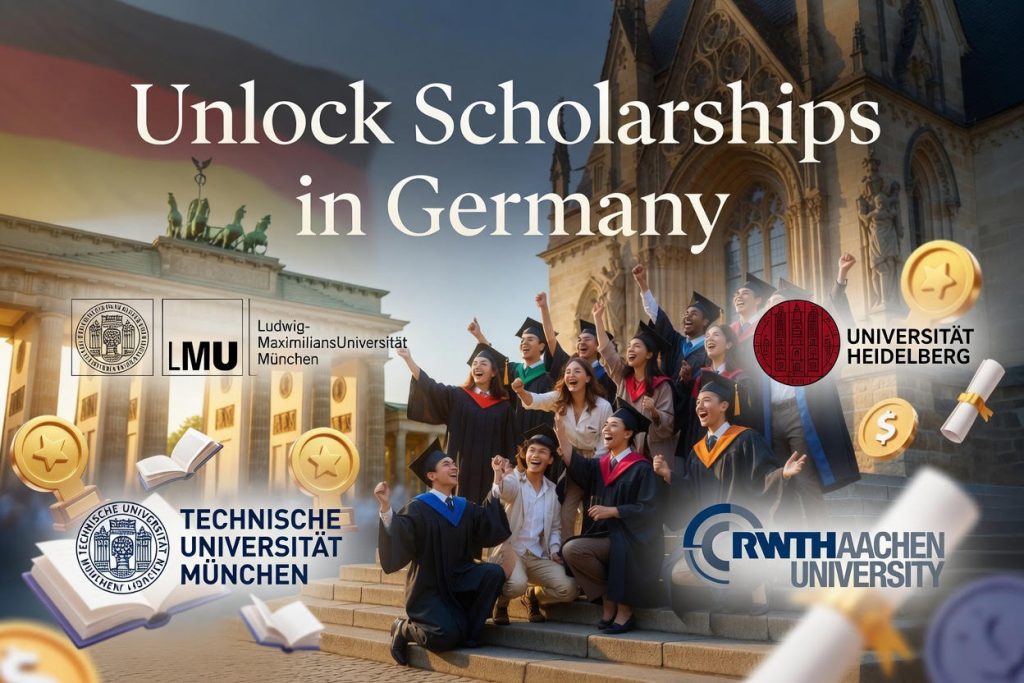
Germany is home to over 400 higher education institutions, many ranked among the world’s best, including Technical University of Munich (TUM), Heidelberg University, LMU Munich, and RWTH Aachen. English-taught programs are common, especially at postgraduate levels, and the country’s focus on research and practical skills makes it ideal for career-focused learners.
Public universities charge a very low tuition fees for most international students (exceptions like Baden-Württemberg’s €1,500/semester for non-EU are rare). This means scholarships in German universities primarily target living costs — typically €900–€1,200 per month. With strong post-study work options (up to 18 months) and a booming economy, graduates often land excellent jobs.
Scholarships in German universities go beyond money. Many include mentorship, seminars, language support, and integration into vibrant student communities. It’s an investment in your personal growth as much as your academics.
Understanding the Landscape of Scholarships in German Universities
Scholarships in German universities come in various forms, making it important to know your options:
- Government-backed programs like DAAD
- National merit schemes such as Deutschlandstipendium
- Political and thematic foundations (Heinrich Böll, Konrad-Adenauer, etc.)
- University-specific awards
- EU initiatives like Erasmus+
This variety ensures there’s something for almost every profile — from high-achieving STEM students to those with strong social engagement.
DAAD Scholarships: The Cornerstone of Funding in Germany
The German Academic Exchange Service (DAAD) is the biggest player, supporting over 100,000 scholars yearly. For 2026/27, programs remain highly attractive with updated stipends.
Popular options include:
- Study Scholarships for Master’s degrees
- Research Grants for PhD candidates
- Development-related programs (EPOS) for professionals from developing countries
What’s covered? Monthly stipends of around €992 for Master’s graduates and €1,300+ for PhD students, plus health insurance, travel allowances, and study grants. Many are fully funded.
Eligibility usually requires a strong academic record, relevant work experience (for some), a clear motivation letter, and language proficiency. Deadlines often fall between October and January for the following academic year — start preparing early!
Check official details here: https://www.daad.de/en/
Deutschlandstipendium: Merit-Based Support for All Nationalities
This national program partners public funding with private sponsors to award €300 per month for at least two semesters. It’s open to students of all backgrounds, whether just starting or already enrolled at participating universities.
What sets it apart? Selection considers not only grades but also social commitment, overcoming challenges, and extracurricular achievements. It’s income-independent and works well alongside other funding.
Apply directly through your target university — deadlines align with enrollment periods. Thousands benefit each year, making it a fantastic entry point for scholarships in German universities.
Foundation Scholarships: Aligning Values with Academic Ambition
Germany’s talent promotion foundations (Begabtenförderungswerke) offer substantial, often holistic support. They look for more than grades — they want individuals who will contribute to society.
Key examples:
- Heinrich Böll Foundation: Focuses on green politics, sustainability, and social justice. Supports Master’s and PhD students with stipends up to €992+ and additional allowances. Ideal for those passionate about environmental or progressive causes.
- Konrad-Adenauer-Stiftung: Emphasizes Christian-democratic values, leadership, and public policy.
- Others like Friedrich Ebert or Studienstiftung des deutschen Volkes for different profiles.
These programs often require German language skills (B2/C1) and include networking events, workshops, and personal mentoring. Applications are competitive but rewarding.
University-Specific Scholarships in German Universities
Individual institutions frequently offer their own funding to attract top talent:
- TUM’s international excellence awards
- Heidelberg University programs
- Opportunities at RWTH Aachen, Humboldt, and many more
These can range from partial support to full packages and often prioritize admitted students. Always check the international office website of your chosen university.
Comparison Table of Key Scholarships in German Universities:
| Scholarship | Level | Monthly Amount (approx.) | Main Focus | Additional Perks | Application Tip |
|---|---|---|---|---|---|
| DAAD | Master’s/PhD | €992 – €1,300+ | Academics + development | Insurance, travel, full coverage | Apply 6-12 months early |
| Deutschlandstipendium | All levels | €300 | Merit + engagement | Sponsor networking | Via university portal |
| Heinrich Böll Foundation | Master’s/PhD | €812 – €992+ | Sustainability, social justice | Study allowance, workshops | March/September deadlines |
| University-Specific | Varies | €300 – full package | Program-specific excellence | Varies | After admission |
| Erasmus+ | Exchange/Short | Varies | Mobility within Europe | Tuition waiver | Through home university |
This table gives you a quick overview to match your profile.1
Step-by-Step Guide: How to Secure Scholarships in German Universities
Getting a scholarship takes planning, but it’s doable. Here’s a practical breakdown:
- Research Thoroughly — Use the DAAD database and university sites to find matches. Identify 4–6 programs.
- Secure University Admission — Many scholarships require or prefer an acceptance letter. Use uni-assist where needed.
- Gather Strong Documents:
- Transcripts and diplomas (certified translations)
- Detailed CV
- Powerful motivation letter tailored to each program
- Recommendation letters
- Language certificates (IELTS/TOEFL or TestDaF)
- Research proposal (for PhDs)
- Submit on Time — Deadlines are firm. Start applications months ahead.
- Prepare for Selection — Some include interviews or workshops. Be ready to discuss your goals and fit.
- Handle Visa and Finances — Prove sufficient funds (€11,904/year blocked account) even with partial scholarships.
Pro Tips for Success:
- Customize every application — generic ones get rejected.
- Highlight impact: volunteering, leadership, or relevant experience matters.
- Improve your German if possible — it unlocks more options.
- Network: Reach out to current scholars via LinkedIn or university forums.
Common pitfalls? Waiting too long, poor translations, or ignoring the “why Germany” question in essays.
Real Talk on Living Costs and Making Scholarships Work
Even with support, budgeting is key. Average monthly expenses:
- Rent (dorms or shared): €250–€500
- Food: €150–€250
- Health insurance: €110–€160
- Transport (often semester ticket): low or included
- Miscellaneous: €100–€200
Total: €900–€1,200. Most scholarships in German universities cover this comfortably, especially DAAD packages.
Part-time work is allowed (120 full days/year), and student jobs are common in cities.
Additional Opportunities and Lesser-Known Gems
Beyond the big names, explore corporate scholarships, Erasmus Mundus joint programs, and country-specific bilateral agreements. Some universities offer emergency funds or integration grants for international students.
For PhD candidates, structured programs often include built-in funding.
Conclusion: Take the First Step Toward Scholarships in German Universities
Scholarships in German universities represent more than financial help — they’re gateways to excellence, cultural immersion, and a brighter future. Germany actively welcomes global talent because diversity drives innovation.
Whether through DAAD’s comprehensive support, the inclusive Deutschlandstipendium, values-driven foundations, or university awards, opportunities exist for dedicated students. The process rewards preparation, authenticity, and persistence.
Start today: Browse programs, polish your documents, and reach out to international offices. Your journey to studying in Germany could begin with one strong application.
Ready to unlock these opportunities? Visit the official DAAD scholarship portal for the latest 2026/27 calls: https://www.daad.de/en/
For even more options, explore this excellent overview: https://www.
You’ve got this—and your dream of studying in Germany may be closer than you think.
The next inspiring success story in scholarships in German universities could be yours.
Every year, thousands of ambitious international students secure fully funded and partially funded scholarships that help them access world-class education, cutting-edge research opportunities, and internationally recognized degrees without the burden of overwhelming tuition costs. What sets them apart isn’t luck—it’s preparation, determination, and the courage to take the first step.
If you’ve been dreaming of earning a degree in Germany, studying at top universities, experiencing a new culture, and building a future filled with global opportunities, now is the time to act. The opportunities are real, the funding is available, and the journey begins with a single application.
Don’t let doubts, fear, or uncertainty hold you back. Every scholarship recipient was once a student wondering if they were qualified enough, competitive enough, or ready enough. They succeeded because they applied—and so can you.
Research your options.
Prepare a strong application.
Believe in your potential.
Take the leap toward your future.
Remember, a scholarship is more than financial support—it’s a gateway to academic excellence, international exposure, career growth, and life-changing experiences.
The opportunity you’ve been waiting for may already be out there. Start your search, submit your applications, and stay committed to your goals.
Your scholarship journey starts today.
Your future in Germany is possible.
The next scholarship success story could be yours.