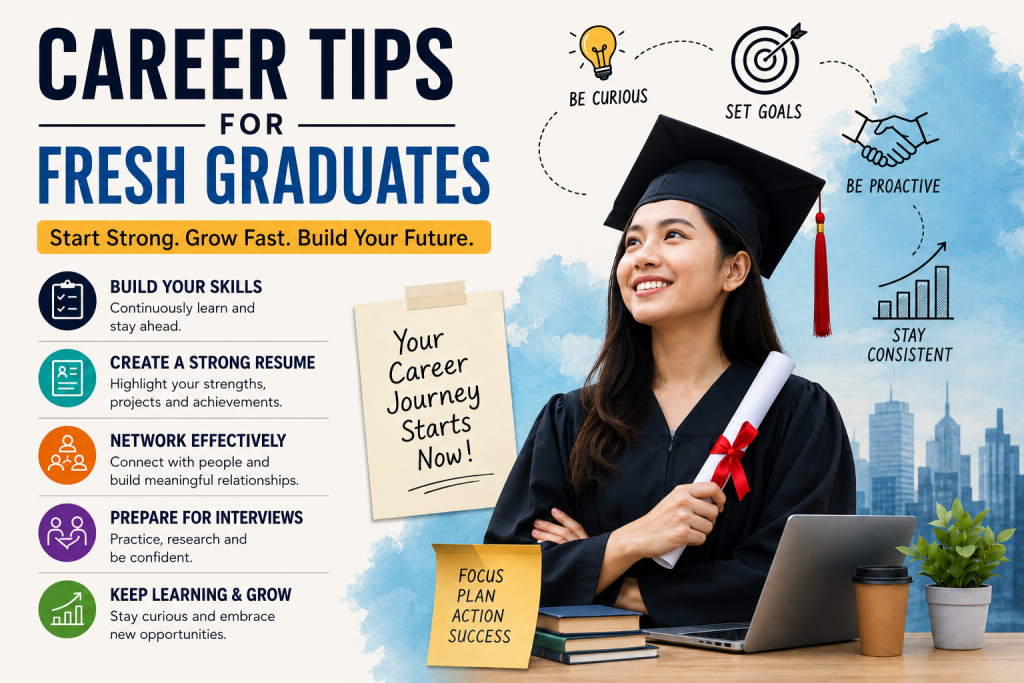
Career Tips for Fresh Graduates: The Powerful Guide to Starting Strong and Building a Successful Career
Every graduate is always happy and excited.
Then reality arrives.
You celebrate the degree, take pictures, enjoy congratulatory messages—and suddenly everyone starts asking one question:
“So… what’s next?”
For many fresh graduates, this stage can feel exciting and overwhelming at the same time. You may expect your qualifications alone to open doors, only to discover that job descriptions ask for experience, recruiters rarely respond, and opportunities seem more competitive than expected.
The truth is that this phase is normal.
Building a career today looks different from what it did years ago. Employers increasingly value practical skills, adaptability, communication, and proof that you can solve problems—not just academic performance.
This guide covers practical, realistic, and effective career tips for fresh graduates to help you move from uncertainty to action.
Why Career Tips for Fresh Graduates Matter More Than Ever
A lot of graduates believe career success begins after getting hired.
In reality, it begins before the first interview.
Hiring processes have become more competitive, more digital, and more skill-focused. Employers often use screening systems, online assessments, and evidence-based evaluation to shortlist candidates.
That means your approach matters.
Your first role may not define your entire future—but your habits during this stage can shape years of growth.
Career Tips for Fresh Graduates: Stop Waiting for the Perfect Job
One of the biggest mistakes graduates make is believing there is one perfect opportunity.
There rarely is.
Your first role should help you:
- Gain practical experience
- Build confidence
- Develop workplace skills
- Expand your professional network
- Understand how industries work
A good first job is often better than waiting endlessly for a dream role.
Many graduates build successful careers by starting in:
- Entry-level positions
- Graduate trainee programs
- Small and medium-sized companies
- Contract roles
- Apprenticeships
- Internships that convert into employment
Career Tips for Fresh Graduates: Build Skills Before You Need Them
Employers are hiring for capability.
Your degree proves you learned.
Your skills prove you can perform.
Focus on building two categories of skills.
Technical Skills
Examples:
- Excel
- Data analysis
- AI literacy
- Project management
- Industry-specific software
- Presentation tools
- Research
Human Skills
Examples:
- Communication
- Teamwork
- Problem-solving
- Adaptability
- Critical thinking
- Emotional intelligence
Recent hiring trends show employers increasingly value a mix of technical competence and strong interpersonal skills.
Career Tips for Fresh Graduates: Create a Resume That Shows Proof, Not Potential
A resume supposed to answer one question:
Why should someone hire you?
Too many graduate resumes list responsibilities.
Strong resumes show outcomes.
Weak Example:
- Participated in group projects
Better Example:
- Led a team of 5 students to deliver a market analysis project ahead of schedule
Include:
- Internships
- Volunteer work
- Academic projects
- Freelance experience
- Certifications
- Campus leadership
Even school activities can demonstrate transferable skills when presented correctly.
Resume Checklist
| Section | Keep | Remove |
|---|---|---|
| Profile | Short summary | Long paragraphs |
| Experience | Results and impact | Generic duties |
| Skills | Relevant skills | Everything you know |
| Education | Degree details | Excessive coursework |
| Projects | Real outcomes | Unfinished ideas |
Career Tips for Fresh Graduates: Networking Is Not Optional
Networking sounds uncomfortable to many graduates.
But networking is not asking strangers for jobs.
It is building professional relationships.
People tend to recommend people they know and trust.
Effective networking includes:
- Attending career events
- Connecting with alumni
- Reaching out on professional platforms
- Asking thoughtful questions
- Following up politely
One meaningful connection can outperform hundreds of random applications.
Simple Networking Formula
- Introduce yourself
- Ask about their career journey
- Listen carefully
- Stay connected
- Offer value when possible
Career Tips for Fresh Graduates: Apply Smarter, Not Harder
Sending 200 generic applications doesn’t always work.
Strategic applications perform better.
Use this approach:
Before Applying
- Research the company
- Understand the job description
- Match your resume
During Application
- Use keywords naturally
- Highlight relevant experience
- Include portfolio links if relevant
After Applying
- Connect professionally
- Prepare for interviews immediately
Quality beats quantity.
Career Tips for Fresh Graduates: Build a Personal Brand Early
You already have a reputation.
The question is whether you control it.
A professional personal brand helps employers understand who you are.
Start with:
- Professional profile photo
- Clear headline
- Portfolio
- Consistent online presence
- Industry engagement
You do not need thousands of followers.
You need clarity.
Ask yourself:
If someone searched my name today, what would they learn about me?
Career Tips for Fresh Graduates: Learn How to Interview With Confidence
Interviews are conversations.
Not exams.
Employers usually evaluate:
- Communication
- Problem-solving
- Professionalism
- Learning ability
- Team fit
Prepare stories using:
STAR Method
- Situation
- Task
- Action
- Result
Practice:
- Speaking out loud
- Recording yourself
- Mock interviews
Avoid memorizing scripts.
Prepared and natural beats rehearsed and robotic.
Career Tips for Fresh Graduates: Understand That Experience Comes in Many Forms “entry-level with experience” frustrates many graduates.
Many companies will usually say “entry level with experience”
But experience is broader than employment.
Examples employers may value:
- Freelance projects
- Volunteering
- Campus activities
- Research work
- Content creation
- Personal projects
- Community leadership
Turn experience into evidence.
Show outcomes.
Career Tips for Fresh Graduates: Use AI as a Tool, Not a Replacement
AI is here to stay and we can only leverage on it.
But employers are not replacing graduates entirely.
Instead, expectations are evolving.
Companies increasingly want graduates who can:
- Use AI responsibly
- Verify information
- Think critically
- Communicate effectively
Graduates who combine AI literacy with human judgment may gain an advantage.
Useful ways to use AI:
- Resume refinement
- Interview practice
- Research support
- Learning acceleration
Do not use AI to pretend you know things you do not.
Career Tips for Fresh Graduates: Choose Growth Over Salary at the Beginning
Salary matters.
But early career growth compounds.
Evaluate opportunities using this framework:
| Factor | Questions to Ask |
|---|---|
| Learning | Will I gain valuable skills? |
| Mentorship | Will someone guide me? |
| Exposure | Will I work on meaningful projects? |
| Growth | Is there room to advance? |
| Compensation | Is it financially sustainable? |
Your first role is often a launchpad.
Career Tips for Fresh Graduates: Keep Building Even While Job Searching
I know it be vey frustrating when you are waiting passively.
Keep moving.
Build momentum through:
- Certifications
- Courses
- Portfolio projects
- Volunteering
- Freelance work
- Industry reading
Small wins reduce career anxiety and increase confidence.
Career Tips for Fresh Graduates: Prepare for Rejection Without Losing Momentum
Sometimes you might be rejected, it happens.
Even highly qualified candidates face silence.
This does not automatically mean:
- You are unqualified
- Your degree is useless
- You chose the wrong field
Track your applications.
Review patterns.
Improve continuously.
Weekly Career Review
Ask:
- How many quality applications did I submit?
- Did I network?
- Did I learn something new?
- Did I improve my resume?
Progress is often invisible before it becomes obvious.
Career Tips for Fresh Graduates: Explore Industries With Strong Entry-Level Opportunities
A lot of sectors are still giving graduates opportunities to work with them, several sectors continue hiring graduates actively.
Examples include:
- Technology
- Healthcare
- Business operations
- Financial services
- Data analytics
- Sustainability
- Customer experience
Growth sectors increasingly reward adaptability over perfect credentials.
Final Thoughts: Career Tips for Fresh Graduates That Actually Work
You cannot have your entire career figured out without first giving yourself the opportunity to start.
Every experienced professional you admire was once a fresh graduate trying to understand what came next. They had questions, doubts, unsuccessful applications, confusing career decisions, and moments when they wondered whether they were moving in the right direction.
The difference is that they kept moving.
As a fresh graduate, your goal is not to have every stage of your professional life perfectly mapped out. Your goal is to begin, learn, adjust, and keep growing.
You do not need to know exactly where you will be five or ten years from now. You simply need enough clarity to take the next useful step.
Build Skills That Make You Valuable
A degree can open a door, but your skills can help you stay in the room.
Take time to develop skills that employers actually value in your industry. These may include communication, research, data analysis, digital marketing, programming, project management, writing, financial analysis, customer service, design, or other technical and professional skills.
Do not wait for an employer to teach you everything.
Use online courses, personal projects, volunteering, internships, professional communities, workshops, and practical experiences to keep developing yourself.
The more you can demonstrate what you know and what you can do, the easier it becomes to communicate your value to potential employers.
Apply Intentionally, Not Randomly
Sending hundreds of applications without understanding what employers want can quickly become exhausting.
Instead, apply strategically.
Read the job description carefully. Identify the important skills and qualifications. Adjust your CV to highlight relevant experience. Write a thoughtful cover letter when one is requested. Research the organization before an interview.
Most importantly, apply for positions that genuinely connect with your skills, interests, education, and career direction.
Quality and strategy matter.
You may still submit many applications, but each one should demonstrate that you understand the opportunity and why you are a suitable candidate.
Network Consistently
Networking is not simply about asking people for jobs.
It is about building genuine professional relationships.
Connect with people working in your field. Attend career events. Join professional communities. Speak with alumni from your university. Participate in workshops and industry discussions.
Ask questions.
Learn from other people’s experiences.
When you approach networking with curiosity rather than desperation, it becomes much more natural.
Someone you meet today may introduce you to an opportunity months or even years later.
Your network can become a source of knowledge, mentorship, referrals, collaboration, and encouragement throughout your career.
Keep Learning
The workplace continues to change.
New technologies emerge. Industries evolve. Employers change the skills they prioritize. Entire career paths can look different from what they did a few years ago.
That means graduation should not mark the end of learning.
It should mark the beginning of continuous learning.
Read. Take courses. Practice. Ask questions. Follow developments in your industry. Learn from people ahead of you.
You do not need to learn everything at once.
Even dedicating a small amount of time each week to improving one relevant skill can create significant progress over time.
Stay Flexible When Your First Plan Changes
Sometimes the career you imagined while studying will not be the career you eventually pursue.
And that is okay.
You may apply for a role and discover that another industry suits you better. You may accept your first job because you need experience and later move into a completely different field.
Your first job does not have to define your entire career.
Think of your early professional years as a period of discovery and experimentation.
Pay attention to what you enjoy, what you are good at, what challenges you, and what kind of environment allows you to perform at your best.
Being flexible does not mean lacking ambition.
It means being willing to adjust your route when you discover a better direction.
Do Not Let Your First Rejection Define You
You may not get the result you want from your first application.
Or your fifth.
Or even your tenth.
That is completely normal.
A rejection can feel personal, especially when you have spent hours preparing an application or interviewing for a position you really wanted.
But hiring decisions involve many factors.
Another candidate may have more experience. The company may have changed its hiring plans. The position may have been filled internally. There may simply have been more qualified applicants than available positions.
A rejection does not automatically mean you are not talented.
Use it as an opportunity to improve.
Review your CV. Strengthen your interview skills. Learn another relevant skill. Improve your professional profile. Ask for feedback when possible.
Then apply again.
One “no” should not become the reason you stop pursuing your future.
Stop Waiting for the Perfect Opportunity
One of the biggest mistakes fresh graduates can make is waiting for the perfect job before taking action.
Sometimes your first opportunity will not have the salary you imagined.
Sometimes it will not be with a famous company.
Sometimes you may have to start with an internship, volunteer role, temporary position, apprenticeship, freelance project, or entry-level job.
That does not mean you are falling behind.
You are building experience.
You are learning how workplaces operate.
You are developing professional relationships.
You are creating evidence that you can contribute.
Your first opportunity is not necessarily supposed to be your final destination.
It is supposed to get you moving.
Build Your Career One Step at a Time
A successful career is rarely one dramatic breakthrough.
More often, it is the result of small decisions repeated consistently.
You update your CV.
You apply for another position.
You learn a new skill.
You attend an event.
You meet someone new.
You improve after an interview.
You try again after rejection.
You accept an opportunity that teaches you something valuable.
Then you repeat the process.
Over time, those small actions begin to compound.
One skill leads to another. One connection leads to another opportunity. One internship leads to a job. One job leads to experience that qualifies you for something bigger.
That is how careers are built.
Give Yourself Permission to Grow Slowly
Do not be too hard on yourself because you have not achieved everything you imagined immediately after graduation.
Everyone’s timeline is different.
Some people get their dream job quickly. Others spend months searching. Some change careers several times. Others discover their direction through trial and error.
Your journey does not have to look like someone else’s.
Instead of constantly asking, “Why am I not there yet?”, ask:
“What can I do today that will move me one step closer?”
That question puts you back in control.
The Best Time to Start Is Today
You do not need to wait until you feel completely confident.
You do not need a perfect CV.
You do not need every skill.
You do not need to know exactly where your career will end.
You simply need to start.
Build your skills.
Apply intentionally.
Network consistently.
Learn continuously.
Stay flexible.
Keep improving.
And when things do not work out the first time, remember that your first result is not necessarily your final result.
Your career is a journey, not a single application.
The small action you take today could become the experience, connection, skill, or opportunity that changes what becomes possible tomorrow.
So update that CV. Search for an opportunity. Send the application. Learn the skill you have been postponing. Reach out to someone in your industry.
Do something today that your future professional self will appreciate.
Start where you are, use what you have, keep learning, and keep moving.
You may be surprised by what happens when you finally stop waiting for the perfect moment and decide to create momentum for yourself.
Your career story is still being written—and the next chapter can begin today.